Skip to content

Typography Journal

Articles from the field of typography.
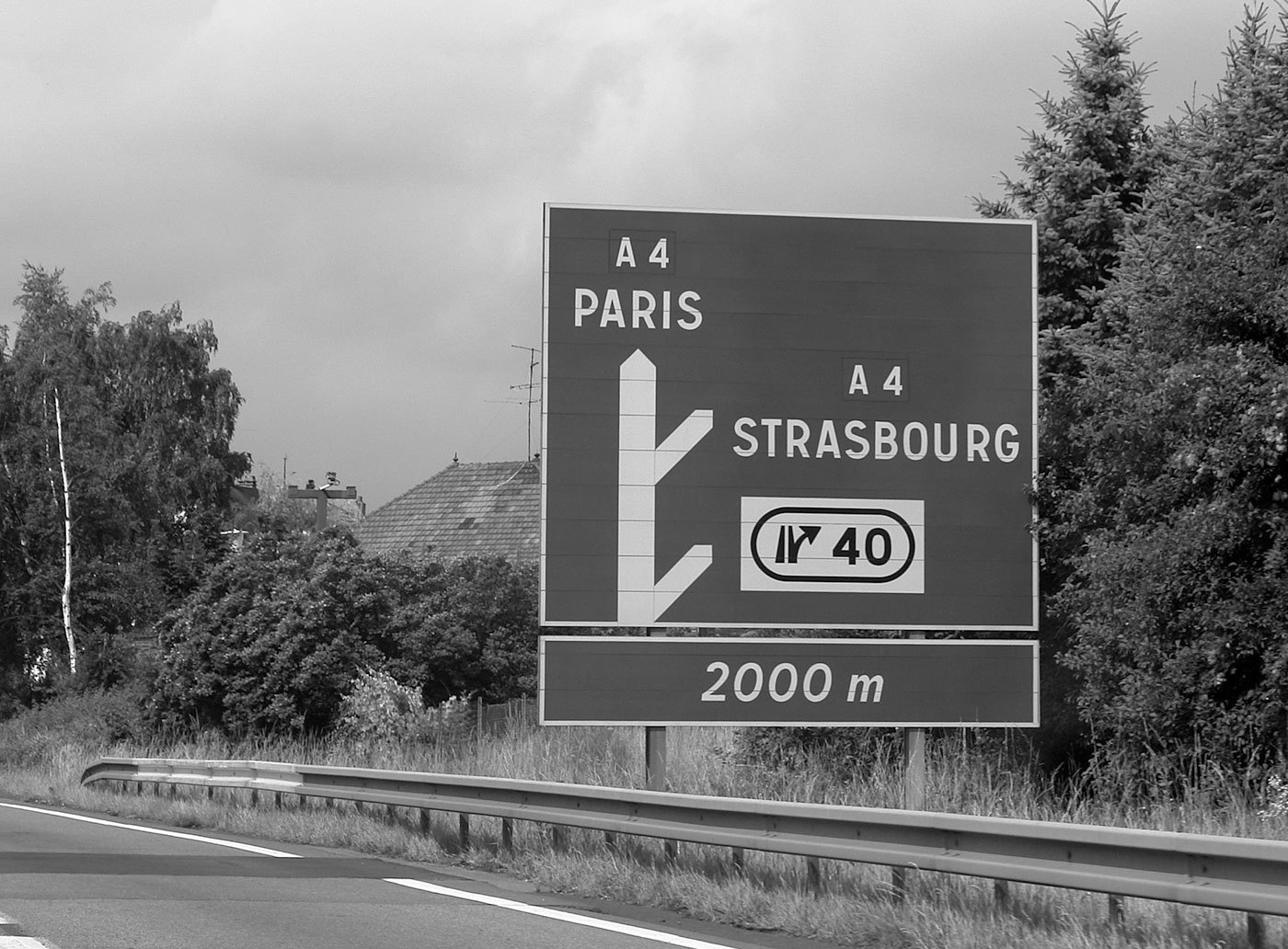
In France four fonts are currently used. The main fonts are called L1 and L2. L1 and L2 are caps-only alphabets. L1 is set in black letters on white background and is used for local targets.

L2 is set in white on blue (Autoroutes) or green (Routes Nationales) background and is used for distant targets. L1 and L2 are basically the same design, but L2 is lighter and set with increased spacing to compensate for the overglow effect of white letters.

The design of L1 and L2 are neither very good nor very bad. It’s a typical semi-geometric design similar to the traffic typefaces used in other European countries. A unique feature are the large counters of P and R. In general it is a good idea to have large counters for a typeface used for traffic signs, but a letter is also recognized by the white-space around it, so they might have overdone it a litte bit. Another problem might be the descenders of Q and Ç, which are designed not prominent enough.

For local target and public facilities the italic font L4 is used. The uppercase letters are similar to the L2 fonts and the lowercase letters bear resemblance to Frutiger’s Univers typeface.


In theory it sounds like a good idea to use different type styles to mark different kinds of targets, but when I look at the different styles and sizes in this image, the result looks rather confusing:

The same is true for the overall design of the signs on which the content looks very scattered. The color coding works fine, but the separated signs and the type treatments don’t give me any clues about a clear hierarchy of the presented information:

An additional font is the L5 alphabet. It seems to be derived from Frutiger and is apparently used for signs of less importance, for example the ones pointing to local points of interest.

A freeware version of L1, L2 and L4 is called Caracteres and can be downloaded from here.  URW++ offers a commercial digitization called Signal.
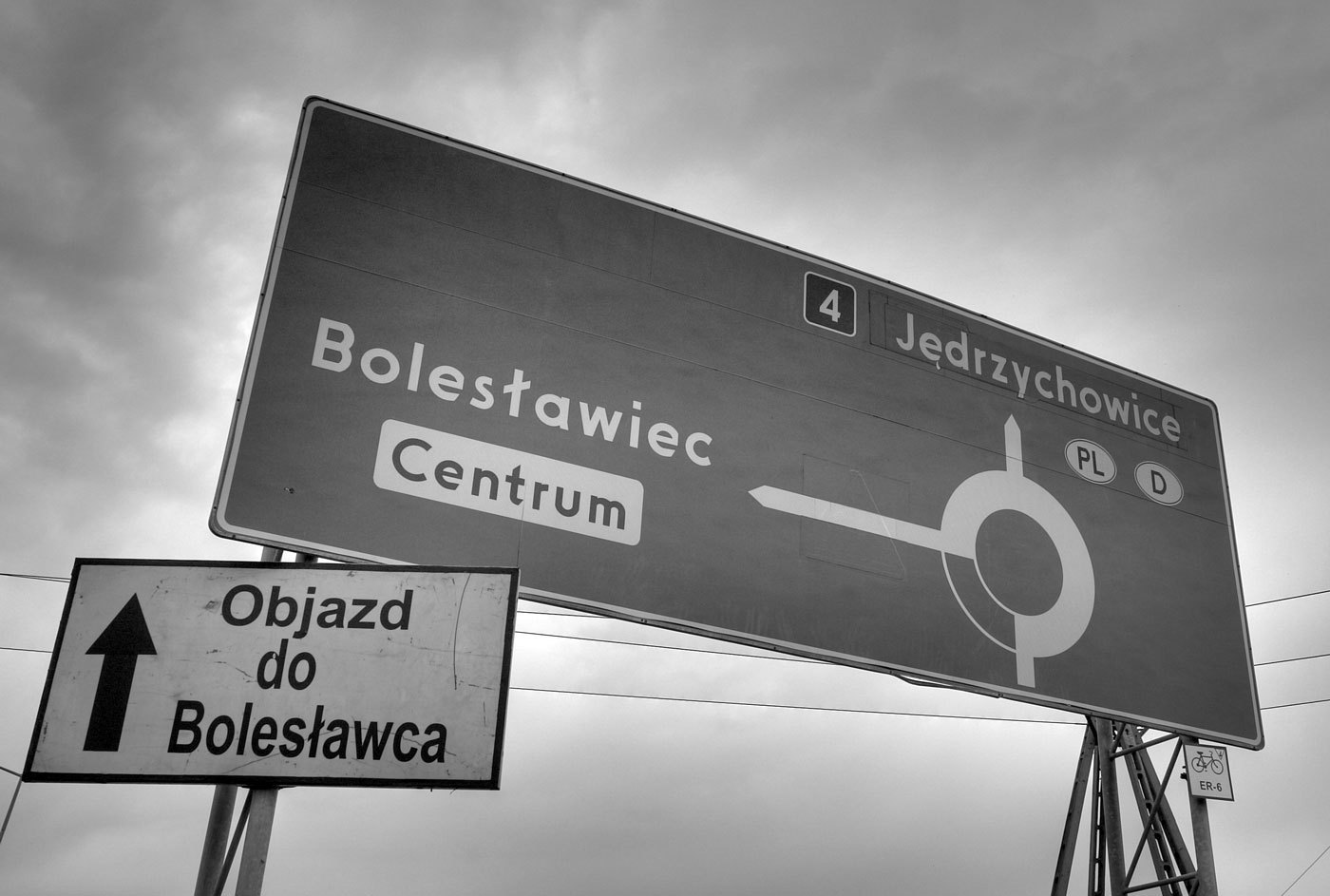
When I first saw a digital version of the Polish traffic typeface, I though I must have gotten a really bad digitization. It had characters which were obviously cut off by mistake …

But I later found out that this is the way the typeface is supposed to look like according to the official specifications:


The typeface has a very simple geometric design almost without any typographic corrections. Only one style is in use. There is no condensed style available and no variations for positive/negative contrasts. The typeface was originally developed in 1975 by Marek Sigmund for the Ministry of Transportation and put into effect on April 1 of that year. It is currently used in accordance with the Ministry of Infrastructure regulation of July 3, 2003 on all types of road signs in Poland. But Poland is a good example that type design isn’t everything when it comes to the design of traffic signs. The Polish signs compensate for the poor type design by making most of the information and direction signs very large, thus still achieving a good legibility.


Unfortunately, the typeface almost always fails when the type has to get smaller. See this next example on a motorway, which is supposed to be read at 110 km/h (70 MPH).

There are two digital versions available: Tablica drogowa by Grzegorz Klimczewski and Drogowskaz by Emil Wojtacki. The latter is freeware and I recommend using the TrueType version. The OpenType PS font has some outline bugs.

The official traffic typeface in Germany is called DIN 1451 and has a very long history. It goes back to the beginning of the 20. century when the Royal Prussian Railways (Königliche Preußische Eisenbahn) defined a new master drawing for the lettering for the description of freight cars, The typeface was later adapted for all kinds of signages of the German railways. In the 1920s major German industrial companies met to agree on all sorts of technical standardization including type standards. The result was called DIN 1451 and was based on the railway typeface. The typefaces were created on a very simple grid system and with a continuous stroke width. The type norm was published in 1936 and became a standard for traffic signs, road signs, street names, house numbers and license plates. Over the next decades the typeface also appeared on all kinds of goods and household articles, making it THE German typeface.


You can read the full story of the history of the DIN typeface in a series of articles by Albert-Jan Pool (designer of FF DIN) in the issues 13, 14, 15, 17 and 18 of the encore magazine.
East Germany
In East Germany the use of DIN 1451 was reviewed in the 70s. In tests with a tachistoscope Gill Sans performed better than DIN 1451 and so Gill Sans was used as the stadard traffic typeface in East Germany. They were certainly ahead of their time in choosing a humanistic sans-serif, but it is obvious that the spacing was way too tight for traffic signs. (But then again, East German cars couln’t go very fast.) When Germany was reunited in 1990 all signs in Gill Sans were replaced with new signs using DIN 1451.

DIN 1451 today
 

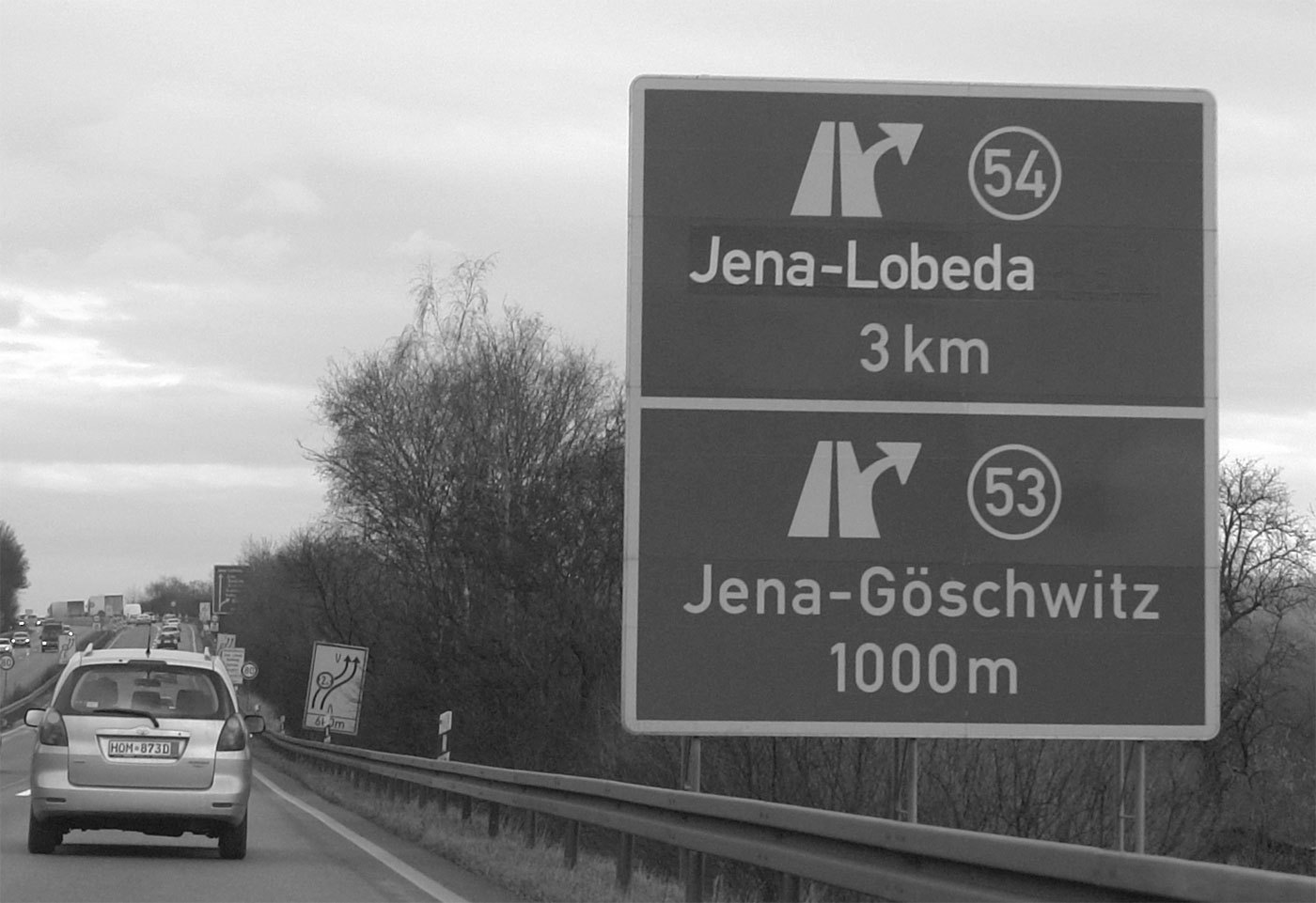
Today two revised styles with typographic adjustments are used. DIN 1451 Mittelschrift is the main typeface:

The condensed style (DIN 1451 Engschrift) should only be used when there is not enough space to use Mittelschrift.

Even in this improved design it is still apparent, that these fonts were never made for traffic signs and reading at high-speed in the first place. The weight and the tight spacing is only working well at a close distance.

Several foundries (e.g. FSI, Linotype Parachute) have developed font families based on DIN 1451. 


download at MyFonts  

download at MyFonts  
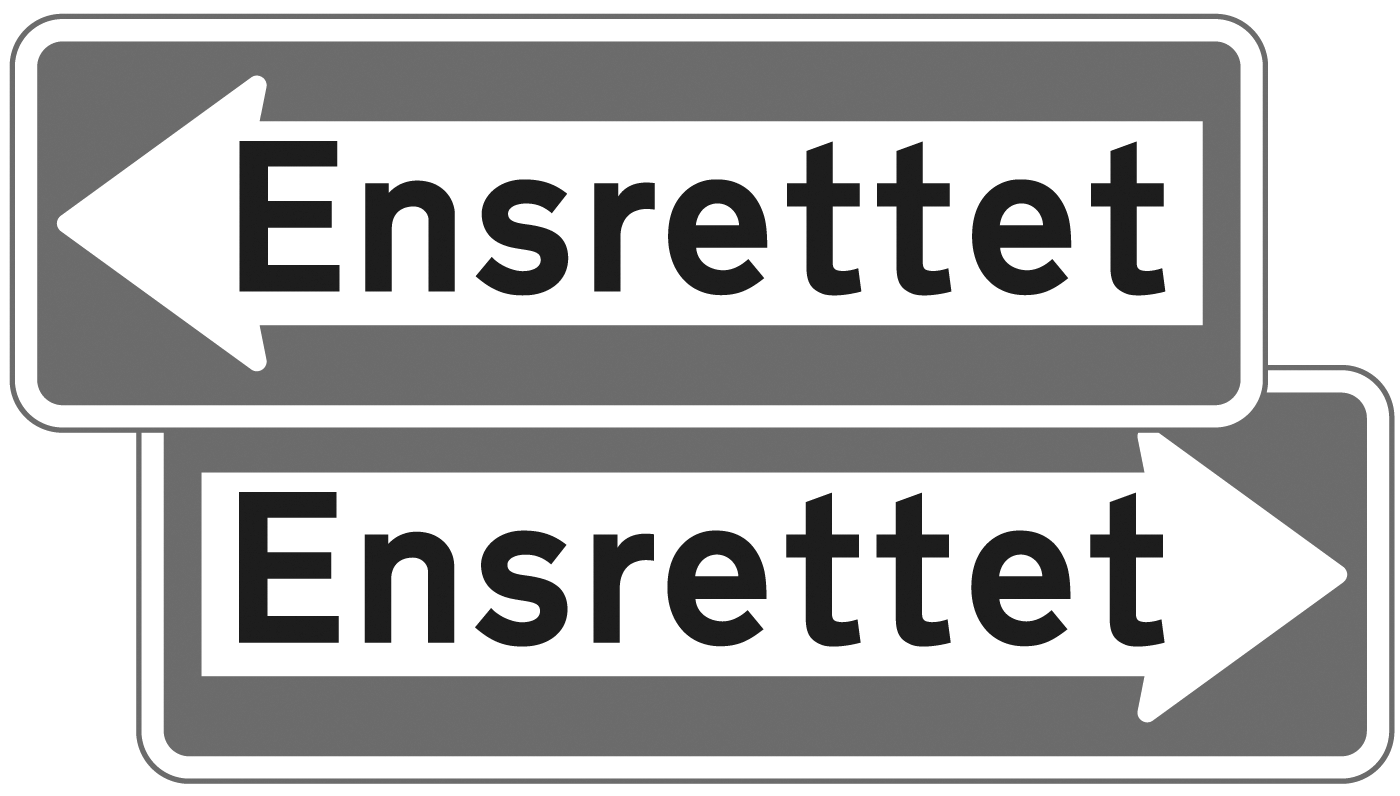
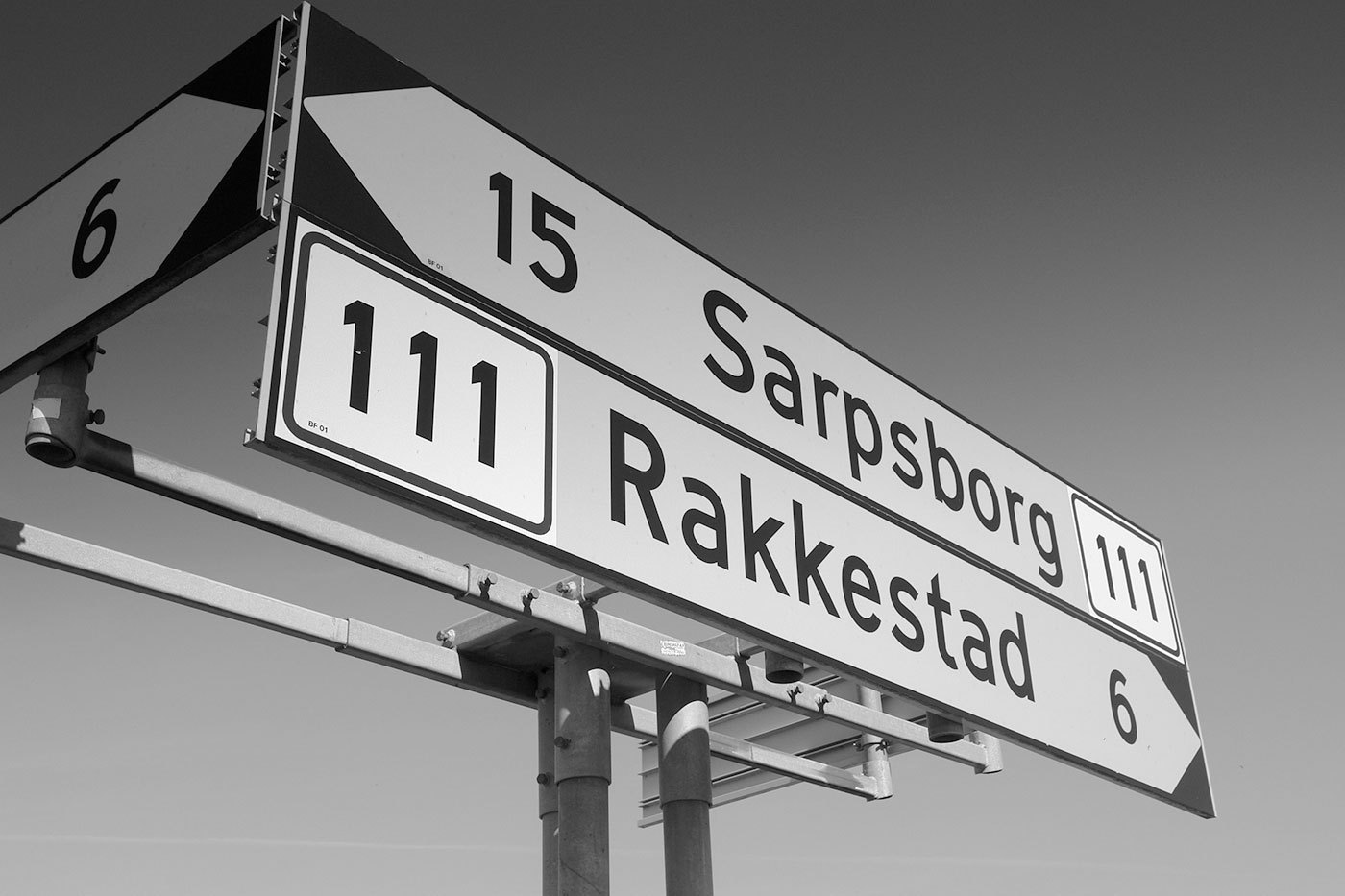
Denmark is very generous with colors. Road sign can be red on white, white on green, blue on white, black on yellow and white on blue. Red (usually reserved for emergency icons) is the main color, because it is the color of the national flag of Denmark.


Between 1955 and 1978 a relatively light typeface with large ascenders and descenders was used (see first line in the above image). In 1978 a new typeface was approved by the Ministry of Transport (bottom line). It was taken over from the British Road Alphabet (“Transport”), designed by Jock Kinneir. The Danish letters æ,ø and å were added and a few details were adjusted. For example: the figures were made more open and the spacing was increased.


The typeface decides the size of the sign. The size of the typeface (cap height: 25–480 mm) is based on the speed of the cars and technical qualities like contrast and retroreflection. Since there is no condensed style available, signs can get very wide.

The Dansk Vejtavleskrift is used in two styles: “Positiv skrifttype” (for dark text on light backgrounds) and “Negativ skrifttype” (for light text on dark backgrounds). The latter has increased spacing, but no changes in weight.


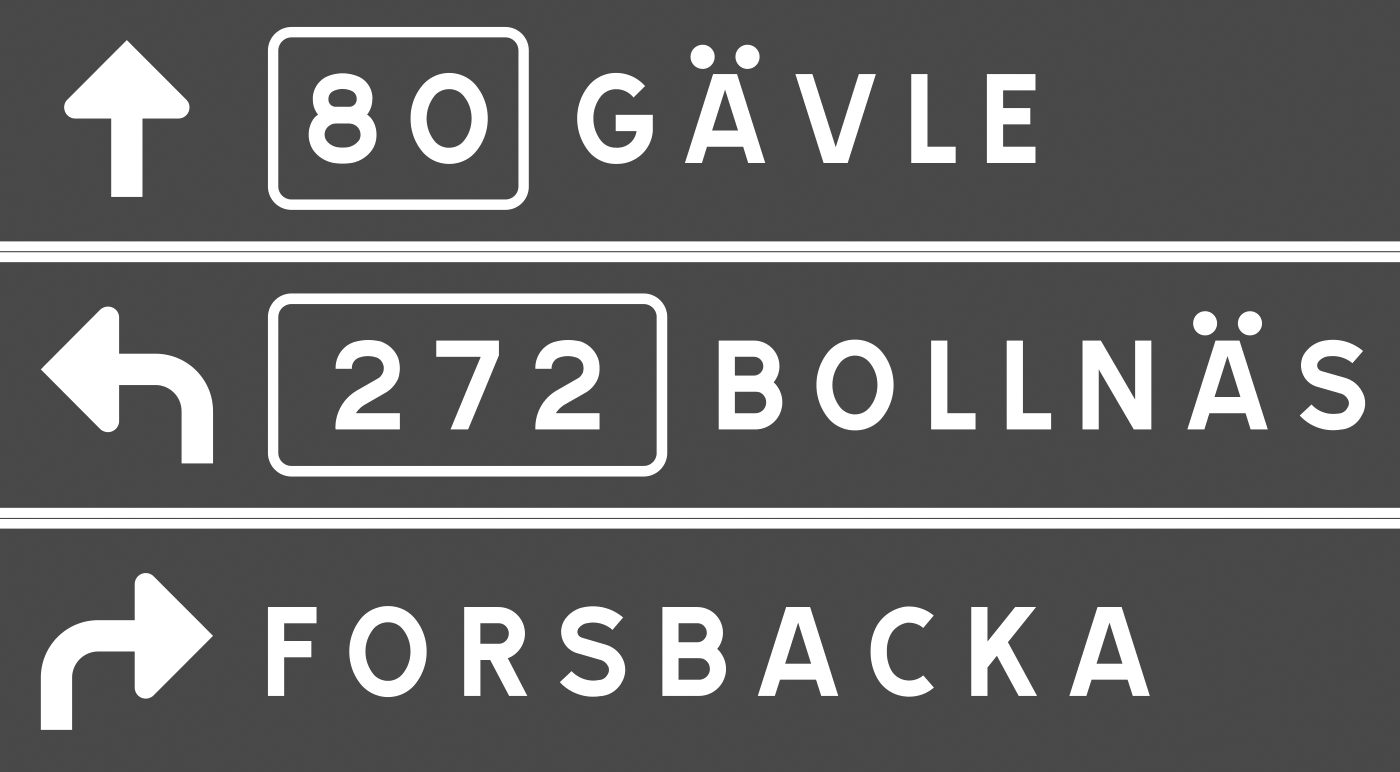
The swedish typeface for traffic signs is called Tratex and was designed by Karl-Gustav Gustafson and modified by Chester Bernsten. Tratex is available in 4 styles.


The first one is called Svart (“Black”):

Vit (“White”). It has an increased spacing to compensate the overglow effect.

PosVersal (“Positive Caps”):

NegVersal (“Negavite Caps”). Identical to PosVersal, but with increased spacing:

Swedish signs are mostly set in all caps. This seems to be a common practice in all Scandinavian countries.

Signs with lowercase letters seemed to be reserved for local targets and tourist information signs.


You can download the Tratex fonts from here. A better commercial version is offered by URW++, but they only have one style.
The typeface on the traffic signs of Norway is called Trafikkalfabetet and was designed in 1965 by Karl Petter Sandbæk.
 

It bears a resemblance to the German DIN typeface, but it also has some unique features, some of them are good, some are bad. Both typefaces share a very simple geometric design and they are good examples of typefaces, that look like they were made on the drawing-board of an engineer rather than designed by a type designer. Look at these letters from Trafikkalfabetet:

A type designers knows how to optically adjust geometrical shapes to make them look right. The tip of the M needs to go below the baseline and the dot of the »i« needs to be wider than the stem. But the design of the Trafikkalfabetet typeface rather aims at consistent values. As a result, the dot of the »i« is way too small, especially for a typeface that should be legible at great distance. The spacing of the typeface has the similar problems. Uniform values for left and right sidebearings cannot create uniform spacing. The counters of Trafikkalfabetet are more open (red circles) and the oval shapes are emphasized (compared to DIN). But on the other hand, important details are better executed in DIN than in the Trafikkalfabetet typeface (green circles).

Trafikkalfabetet has only one style. So for longer pieces of information you can only make the type smaller or the sign longer.

A digitized version by Jacob Øvergaard is available here.
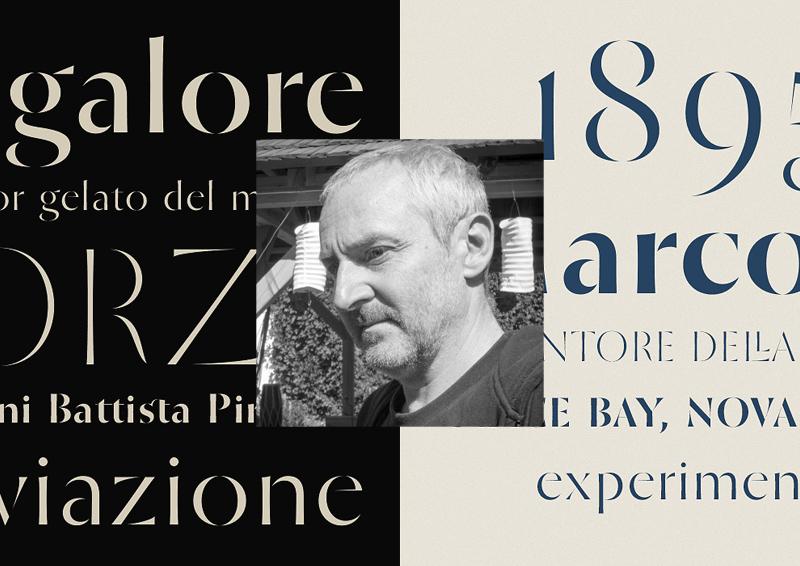
1. On which project are you currently working on?
My students will open their exhibition next week on Bitov castle in south Moravia (in Czech Rep.), I’m organizing lots of things around it. Teaching is my strongest interest since 2003. Now I’m cooperating with students Tomas Brousil, Radana Lencova and Radek Sidun on a project of new typeface system for schools — all degrees from primary to universities. We have already designed 8 OpenType fonts, serif/sans families suitable for primers and scientific books at the same time.

2. What are you reading at the moment? Do you have a favourite book?
I’m reading texts of my students, besides that I have to read books when designing them, I read lots of czech fiction literature. I've so may books so I move them slowly to my cottage from my Prague’s studio in believe that I’ll read them quietly in future far from civilization and stress. I love to red alone, among woods and ponds. Authors? Jaroslav Hasek, Jan Kresadlo, A. Schopenhauer, R. Feynmann, D. H. Thoreau, and yes, I read some poetry, too.
3. How do you proceed when you design a typeface?
I shouldn’t say it among students, but I don’t begin with handdrawing, my computer is my sketchbook. Recently I bought a second-hand Psion Revo with Sketch application which produces funny rough pixel images made with pen on touchscreen. But seriously, everything starts with specific order or insufficiency. If I need some typeface for my layout, I simply design it.

4. Where do you find inspiration for your type design?
In history and in individual experiment. first I need to know the roots, than I need to express myself.

5. How do you find the names for you fonts?
It is getting harder, many good names are already occupied in the industry, I experienced twice an unwanted collision so I had to change my naming. I assume a good name of font should always reflect something from the soul or atmosphere, the story behind specific type. Sometimes it is just the name of inspiration source, Walbaum for example — obvious and simple. My “Sebastian” is different, because it shares my personal crisis in 2002–2003, I expressed my pain with type …

6. The 20th century has seen many stylistic changes in type design. Do you currently see a trend for the new century?
New century is a clichee expression and so is the scene in graphic design. Fashinable, boring, aggresive and, above all, copying and borrowing already proven methods. I believe in “less is more”. And graphic design is not everything. As I’m getting older, I ask for the subject, the meaning of designed thing. There are many interesting innovative styles in non-commercial area of type design, I believe in the generation of my students, they can bring refreshing ideas based on a broad social dialogue, not narrowly focused on design only.

7. Nowadays digital type designs can spread around the world in seconds. Do you think local styles of type design will become more or less important in this time of globalization?
In terms of availability of fonts, small foundries are more flexible than big ones. You won’t see anything new from big companies (you know them) except for merging libraries and confusing users. Local designers can sway the global scene more effectively than ever before. That's what Erik Spiekermann said ten years ago, and nowadays it becomes true for good. In my country, many clients believe in strong identity through logo and its repeated exposure. I advise them rather to show their products and ideas with the use of original font adjusted for their purposes. It can carry the identity by verbal interaction instead of “building an image” which may be unfaithful.

Important Information

We are placing functional cookies on your device to help make this website better.

Account

Navigation

Search

Search

Configure browser push notifications

Chrome (Android)
  1. Tap the lock icon next to the address bar.
  2. Tap Permissions → Notifications.
  3. Adjust your preference.
Chrome (Desktop)
  1. Click the padlock icon in the address bar.
  2. Select Site settings.
  3. Find Notifications and adjust your preference.