Skip to content

Typography Journal

Articles from the field of typography.
Today’s demand for a capital ß (“sharp s”) character is a functional demand. And a very simple one at that. It logically follows from two points: 
How the lowercase ß character is used today in the German alphabet How the Latin script works today as double-story alphabet Put these things together and it should be clear that the ß requires an uppercase counterpart like any other Latin character as well. So people still arguing against the capital ß will usually just ignore the functional aspects of it. They have to. Instead they typically argue in one of two ways:
“because something in history …” or “because something is wrong with the design”  The history of the character ß is an interesting topic. It might be one of the most interesting ones of all the Latin characters which developed over the last couple of centuries and I discussed what we know about this history in previous articles. But whatever you know (or think to know) about the history of the character—it cannot be a proper argument against a capital ß, because it has no influence on the two bullet points listed above. So it’s by definition irrelevant. And very often people arguing this way actually know very little about the history of the character. They just go by simple claims they picked up many years or even decades ago, which might not even be true or it might just be a tiny piece of the puzzle. 

But what about the design arguments against the capital ß? Now that the character is part of the official German orthography, the design argument seems to be the last straw for the “grumpy holdouts” in our field still rejecting the character. And of course it’s the most tricky aspect, since whether or not all or specific capital ß designs are successful is subjective. If someone likes or dislikes all or specific capital ß designs, everyone else might just want to respect that. It’s just an opinion and probably an honest description of a personal perception. But people might also argue for their opinion. They might try to give objective reasons why something is supposedly intrinsically wrong with the typical capital ß designs or even the idea of the capital ß itself. And those reason can and should be checked. Normally, the burden of proof would be on the ones making such claims. But unfortunately, after all these years debating the capital sharp s, not a single article has been written trying to make a convincing case against its design or existence. All we get is short social media posts with opinions and bold assertions. So let’s look at the reasoning we can gather from these posts against the capital sharp s design. 

Examples of modern capital sharp s designs: Scotch Modern, Goodchild Pro, Rooney
Most capital sharp s designs today are based on a kind of “capitalized” ß, i.e. a design derived from the lowercase sharp s. That shouldn’t be a surprise. This design is instantly legible without requiring millions of readers to learn a completely new letter. At the same time it fixes the typographic problems one would create by putting the lowercase ß between capital letters as a work-around for the previously missing character. And this was and still is common practice. Even official documents like German passports did it this way to maintain the correct spelling of names in uppercase. But typographically, the ß character, like any lowercase character, isn’t meant to be put between uppercase characters. It might have a different height and it doesn’t use uppercase proportions. A capital sharp s based on a capitalized version of the ß can fix these problems. And so all functional and typographic problems are solved this way. Yet, some typographers, type or graphic designers insist, that this approach is somehow flawed and any capital sharp s created this way is intrinsically flawed because of it. In the most general way those people say: 
“You can’t create an uppercase character from a lowercase character.” But most of the time it is actually phrased this way: 
“You can’t create an uppercase character from a lowercase ligature”.   Well, let’s look at those claims logically and one by one.
The first one is based on the knowledge, that the (basic) set of Latin uppercase letters existed first. The lowercase letters came later and the claim essentially suggests, that this is the “natural order”, which can’t be reversed. The claim can be understood in two ways: either it talks just about the order of the development or about the designs that follow from that order. The order itself can hardly be used against the capital ß, because the same argument could also be used against the German umlauts (ä/ö/ü), which also existed as lowercase first. But no one really questions their existence, do they? 
But what about the design? Can we derive a proper uppercase shape from a lowercase character? Well, of course we can! Characters, not unlike words, are human-made cultural tools of communication. We create and shape them as we need them. And we have done this for thousands of years. If there is a functional demand for a word, we create it. If there is a functional demand for an uppercase letter, we can create it as well. The only reason this specific demand didn’t exist in the past was that German was mostly set in blackletter, which used mixed-case typesetting only. And since the ß never appears at the beginning of words, there simply was no demand for a capital version. Now this demand exists and and so now we create the letter. Plain and simple. 
But can we “reverse-engineer” the design process so to speak? And do we have to do that? Because one could argue, that the perfect capital ß would be one that could have existed 1000 or 2000 years ago and then later turned into the lowercase letter ß we use today. And people then argue, that the typical capital ß designs today are intrinsically flawed, because they don’t do that and just jump from lowercase to uppercase by “capitalizing” the lowercase shape. They basically say, that as long we can recognize the lowercase ß in there, it remains a lowercase letter and as a capital letter design is therefore flawed. So what about this argument? 
I fail to see any logic in it. It’s the reasoning you come up with while doing post-hoc rationalization. Because it just isn’t in line with reality. Again, we can look at the history of the German alphabet. German blackletter is full of (what we today consider) lowercase shapes turned into uppercase. 

Sachsenwald
A blackletter H can be seen as the lowercase shape turned into an uppercase letter by changing the proportions and adjusting the design to fit the other uppercase letters. And that is exactly what is currently happening with the capital sharp s designs. But why do some consider this wrong for the capital ß, but they don’t complain about those blackletter shapes? If it happened in the past it is okay, if it happens today it is flawed? 
And to fully drive this point home, just consider this thought experiment: A type designer would have been shielded his or her whole life from seeing the Latin letter s/S. And then one day we show him or her the lowercase letter and ask the designer to create a proper uppercase version. What would the designer do? Well, we can’t know for sure, but it wouldn’t be surprising if the designers takes the letter skeleton of the lowercase s and enlarges it regarding its size and proportions to fit the other uppercase letters. The result could look exactly like our S looks today. But would this shape now be flawed because the lowercase character came first? Of course not! That would obviously be an absurd claim in this case. But it is the same claim people keep using against today’s uppercase ß designs. 

Today’s capital sharp s designs are nothing new by the way. As an example, this typeface from 1915 (“Koralle”) already used an uppercase design based on the lowercase design
Visual similarities between a Latin uppercase letter and its lowercase counterpart aren’t a flaw—they are perfectly normal. Some character pairs (like S/s, as well as ones based on ligatures such as W/w) are very similar, others less so. But either way—it’s not a criteria for good or bad letter designs. The design of the S isn’t wrong, because it can be seen as a capitalized s. The blackletter H isn’t wrong because it looks like a capitalized h. And the capital ß isn’t wrong, because it looks like a capitalized ß. This is a logic in line with the reality of the Latin script. 
A good or bad letter design depends on the the skill of the type designer. Today’s Latin fonts need to work in both mixed-case and uppercase-only typesetting. That is the challenge for the type designer and with the capital sharp s being new, not all designs might be perfect yet. But logically, there is just no intrinsic flaw just because the lowercase letter came first. Simply knowing what came first, doesn’t affect how the readers perceive and read those letters. 
 
Now let’s move on to the ubiquitous ligature myth. Some people in our field seem to be unable to to see the letter ß as anything else than a ligature. And starting with that as a premise, they come to typical conclusions like: 
if it’s a ligature (like fi/fl) it’s not really a regular letter and there is no need for an uppercase version.  We won’t address this in detail in this article. But the conclusion is wrong since the premise is factually wrong. Today, the sharp s cannot be grouped with typographic ligatures (like fi/fl). It anything, it would have to be grouped with character such as w and æ — regular characters historically probably derived from ligatures. 
But when type designers understand the ß as a ligature of two lowercase letter, they might think that an uppercase version needs to follow the same logic and so the uppercase ß must be created from the uppercase counterparts of whatever lowercase parts the ß is made of. And since there is supposedly a long s (ſ) in the ß design, some might conclude that a capital version cannot be created at all, since there is no capital ſ. 
Once more, I fail to see any good reasoning behind such claims. First of all, if you think the original lowercase parts of the ß matter and should be used for the uppercase version as well, which parts would those even be and how can you be sure to pick the right ones? Because at this point, there isn’t even scientific consensus about the origin of the ß. There is a single paper by Herbert E. Brekle, which can be considered scientific. But it mentions several possible sources. It might be one of those. It might be a combination. There might be other theories and sources that still need to be explored. Considering this status quo, it’s really surprising and disappointing how many designers and typographers claim to know what the ß was and therefore supposedly also “is”. (Which by the way is another logical fallacy.)
But even if we would know for sure what the original parts of the ß are and if we happened to have those available in the uppercase alphabet: Would we need to create a new ligature from those individual uppercase letters? No! Case in point: We didn’t do that with the umlaut characters either. A German ä has definitely developed from merging lowercase a and e. When the uppercase versions were created much later, they didn’t use an Æ design to recreate the merger of a and e in uppercase as A and E. The type designers and writers of the time adopted the common design of the lowercase umlauts for the uppercase versions as well. At that time, that usually meant to put a lowercase(!) e on top of the uppercase letter. Not a very logical thing to do in terms of type history, but an understandable solution nevertheless. And one that isn’t questioned at all in hindsight. So why shouldn’t we be able to do that with the uppercase ß as well?
And last but not least, there is another problem with the typical ligature arguments against the capital sharp s designs: It ignores the two historic branches of the German alphabet: blackletter and roman (or “Antiqua” as it is called in German). The sharp s was established when blackletter was the dominant type style in Germany. There is no doubt about that. But if we talk about the design of today’s typefaces, we hardly ever mean blackletter typefaces. We mean the roman designs. But it is a fact that the roman ß hasn’t developed from a ligature. It hasn’t developed at all. It was introduced by a committee as a new character with a new design at the beginning of the 20th century.

The ß design as introduced and used in the early 20th century. 
The left part does indeed look like a long s (ſ), but that special character had already been removed from the roman orthography of the German language at that point. And the right part was neither a roman s, nor a roman z. So calling it a ligature actually makes little sense. If anything, it hints at a ligature design. It didn’t develop from a ligature, nor did the “parts” even exist individually in the orthography they were used in. What was created was a single roman letter with its own unique design. And that by the way is how the vast majority of people in Germany and Austria perceive it. They don’t see a ligature in the character w and they don’t see one in the character ß. It’s one design in both cases. 
So if we talk about the design for the roman capital ß, what else should it be based on than the lowercase ß? Why go further back than its introduction at the beginning of the 20th century? Why go by our sketchy knowledge about blackletter predecessors? In today’s roman typefaces, we hardly ever draw any German character (ß, ä/Ä, ö/Ö, ü/Ü) the way they looked in blackletter. So why would the capital ß—as the only exception—have to be based on asserted historic lowercase parts in blackletter put together again as uppercase ligature? It’s just not conclusive and the logical fallacy of special pleading. 
 
In conclusion: if some people don’t like an uppercase ß that reminds them of the lowercase ß, so be it. But I can’t see how you can make a case, that this would be an objective flaw of such designs. If the existing uppercase characters are allowed to have similarities to their lowercase counterparts, so does the capital ß. Insisting that a capital sharp s with similarities to the lowercase ß remains a lowercase letter or ligature because of those similarities—even though it was specifically drawn as uppercase letter with uppercase proportions—is frankly an absurd claim because it is not in line with the reality of the Latin script. And the assumption, that the ß character developed from a ligature also doesn’t change anything in that regard. If you accept German umlaut characters not to be drawn from their historic parts, then logically you should accept the same for the uppercase ß. 
The Latin script has a history spanning over thousands of years and characters were added all the time. There is nothing special about the current change of adding a capital sharp s. In the future and in hindsight, neither this change nor the design will be questioned. Just because this single change out of the hundreds of changes happens in the present and is in conflict with the typesetting conventions one grew up with, doesn’t mean that it is flawed. Sure, a new character might briefly stand out because it is new. But that doesn’t mean there is something wrong with the design. In the end, it’s all in the hands of today’s type designers. We know they can draw a coherent set of over 100 Latin characters and all sorts of optional ligatures—nothing is stopping them to make their capital sharp s designs work just like any other Latin character. 
Letterpress version and type specimen of Bona
Mateusz Machalski started the project in 2011, when he was in his second year at the Academy of Fine Arts in Warsaw. The font had only existed in metal type and it was available in the typesetting room of the academy. When Machalski became interested in the font, his professor arranged a meeting with its designer Heidrich. “I was surprised that he did not laugh at my projects. It made me more confident and I told him about my idea. He reacted with real enthusiasm” Machalski remembers. Digitization started quickly after that meeting, but the work remained unfinished for a few years.

In 2016, together with Leszek Bielski, the project was revived again. More meetings with Heidrich took place and an extended type family (regular, italic, bold) was planned. Bona was Heidrich’s only full type design. But as graphic designer in those days, lettering for book jackets for example was a typical job. But there was little choice for body copy texts.  “We always worked with 12 pt Times or Garamond—to the point of boredom. Each book looked the same inside. There was a deep need for new typefaces. For each cover or other design the lettering was custom made. It had to be drawn or painted, as there was not enough time to create and cast new letters.”


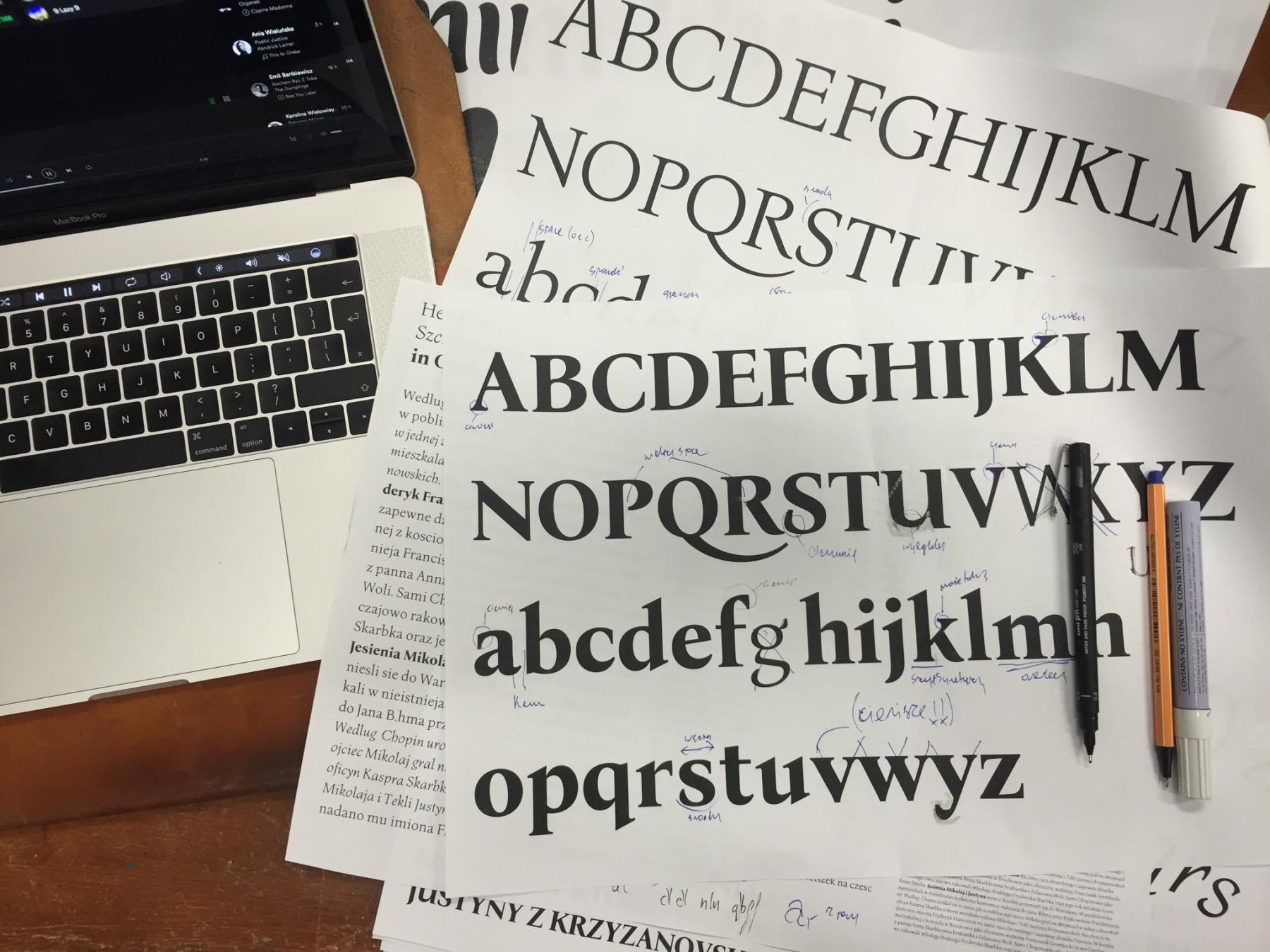
Original sketches and matrices
Heidrich worked on Bona as a side project—for the “pure pleasure” of it as he remembers. There was no specific brief or job for the design. The typeface was cast and a full set ended up in the typesetting studio of the Academy of Fine Arts in Warsaw, where it was used occasionally. 
For the digitization Heidrich provided all the original sketches of the italic and the matrices could be inspected as well. But there were still so many design decisions to be made for the digital version. “With Bona Nova, the most interesting things happened during the design work. I published images and details about the progress on the internet and the Bona Nova fanpage became a stage for a typographic debate on many levels” says Machalski. 

Among other details, the design for the Capital Sharp s was heavily discussed on Facebook
And of course a roman design had to be developed from the italic, which is rather unusual. Letters on stamps and banknotes by Heidrich helped to work out certain characteristics. The final designs got an extended Latin character set with over 1000 glyphs, including small caps, lots of ligatures, multiple figure sets and ornaments.

But the family still continued to grow. Three inline versions were added and three title versions with a very high contrast. These are available as commercials offers. And there might be more in the future. “There are some plans—perhaps Cyrillic? Maybe a sans serif version … Only time will tell.”


Specimen images from Bona Nova

The free styles of Bona Nova

The commercial styles of Bona Nova
The free and the commercial styles are available on the Capitalics website.
More information about the project in Polish and English here: http://bonanova.wtf
Today we take it for granted to use fonts for almost anything. Not just printed matter, but also logos, stamps, t-shirts, neon letters, and so on. Anything is possible—we just need to provide an image file. But this is a rather new development, considering how long movable type is in use. Over more than 500 years, fonts (made from metal or wood) were connected to letterpress printing, were each letter had to be made in the target print size, arranged by a typesetter, inked and finally printed on a surface like paper. That’s how things like the text block of books, flyers, letter heads, business cards, or posters were being made. But this technique was not suitable in many other areas. Think of a 50 inch sign on a train station building for example. It wouldn’t make sense to create a set of 50 inch letters just for this case and then press these huge letters against a sign or even the building wall itself. It was done differently and the following sections describe typical areas where letters were often not created using fonts.   
The Signpainter
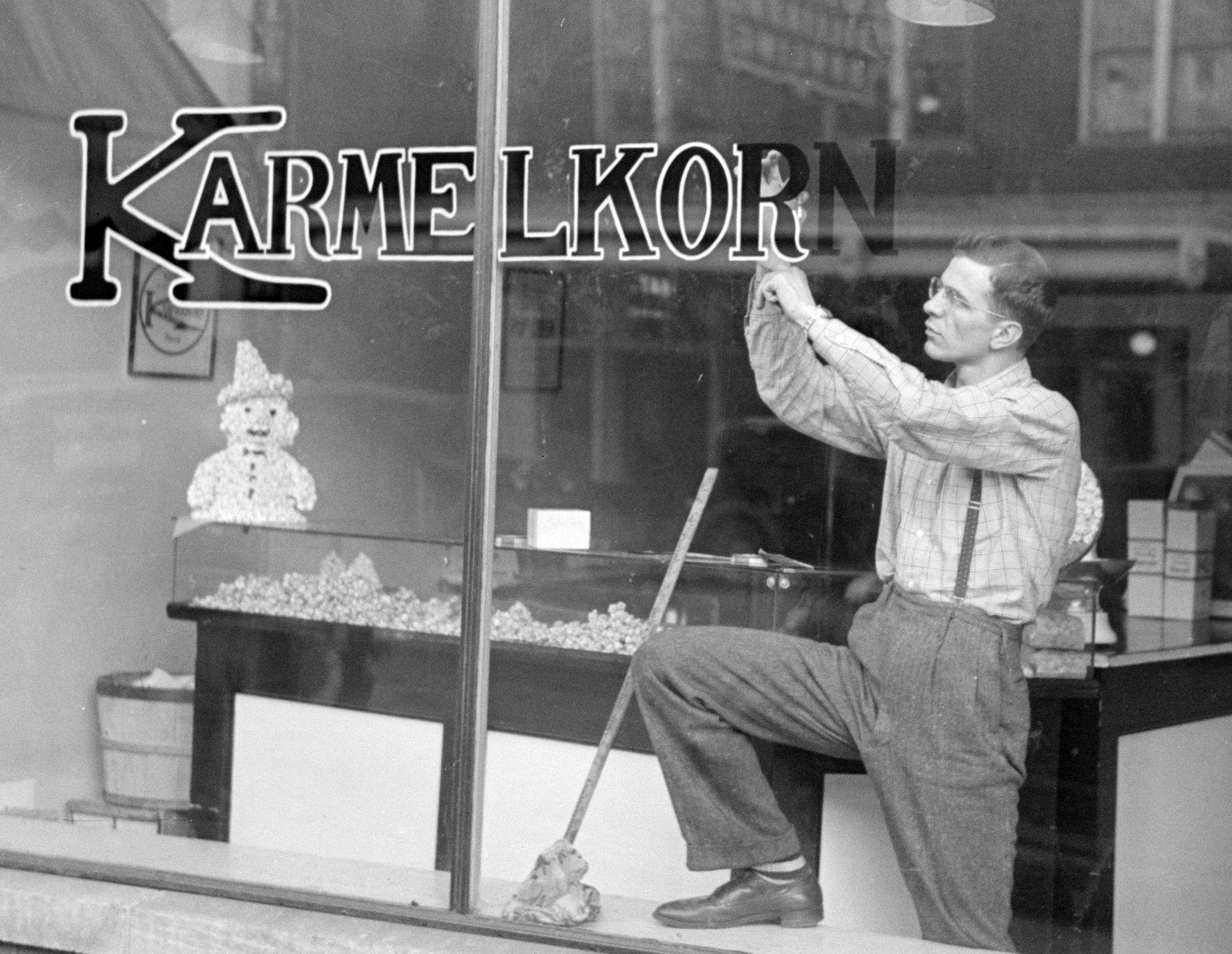
Signs over shops or on shop windows, political banners, train station signs, advertising boards and banners, large-scale ads on walls—those are all uses usually created by sign painters in the past. A sign painter could draw or write alphabets in many different styles, but his job had little to do with the letterpress letters used in print shops. The sign painter’s tool were brushes and pencils and every sign was usually a unique design, with letters specifically drawn for this one use. That’s what we call lettering.   


Sign painter training
But it wasn’t just advertising. Even street signs, or the signage for busses or trains could have been lettering. If the same letters had to be repeated over and over again, there might have been stencils or technical drawings for each letter. But those were usually just for internal use, not sold publicly like letterpress fonts. And because of that, there was often not even a need to name the sets of letters just used internally. And so we also cannot identify a certain name in hindsight. The only chance is that the sign painter’s alphabets were interesting enough for someone to create a font later based on the original lettering design. 

A sign painter working on streetcar signs in the 1940s.

Older logos, like the one from Coca-Cola in this case, were almost always drawn, not made from fonts
Logos and mastheads
Setting the logo of a brand or company in a certain typeface—or at least to base the design on a typeface—is very common today. But before the computer, logos were almost always created as individual drawings by a graphic designers. The same is true for mastheads of newspapers and magazines. They weren’t printed every time from moveable type. The were designed once and then turned into a printing block or “logotype”. In fact, this is were the term logo comes from originally. Combining several letters or full words to one unit was called a logotype (from Greek: logos → word). And since this was so common for the names of companies, logotype (or logo for short) became a synonym for visual trade marks of any kind, even the ones that don’t contain letters or words.  

Book covers
The body copy of books is usually being printed from moveable type since Johannes Gutenberg. But the same was not necessarily true for book covers and dust jackets. They are designed by illustrators and graphic designers and before the computer, if there were letters, they were created as lettering—drawn in the original size just for this one use. And while it was less common, title pages or pages starting new chapters could also get such a lettering treatment. 


Product lettering
Clock faces, food and cosmetics packaging, tube radios, vacuum cleaners, coffee makers and so—letterpress fonts weren’t suitable for putting letters on such products in the past. So even if the design of letters on such product looks similar to letterpress fonts, they were usually not made using fonts.  


Stonemasonry
Just as the sign painters created the lettering on signs, stone cutters created the lettering on stones, may it be inscriptions on walls, tombstones, or on plaques mounted on buildings. And even while the letters might look as uniform as the ones in a typical font, before the computer, such stone cuttings were usually not made using fonts. The letters were designed and carved by the stone cutter for the specific application. 

Handwriting/calligraphy
Most of the examples mentioned above fall into the category we call lettering. But letters can also be created with a another technique, that neither is lettering nor uses fonts: handwriting (or calligraphy, as we call it as an art form). Many requests in our font identification forum simply show handwriting, but people still ask for a “font identification”. Typing everything has become so common today, it might not even occur to people anymore, that things like logos, poster texts, or advertising claims might be handwritten. And modern script OpenType fonts might indeed even look a lot like lettering or calligraphy. But usually, if one takes a closer look, handwritten texts and fonts can still be distinguished very clearly. 

Defining the terms
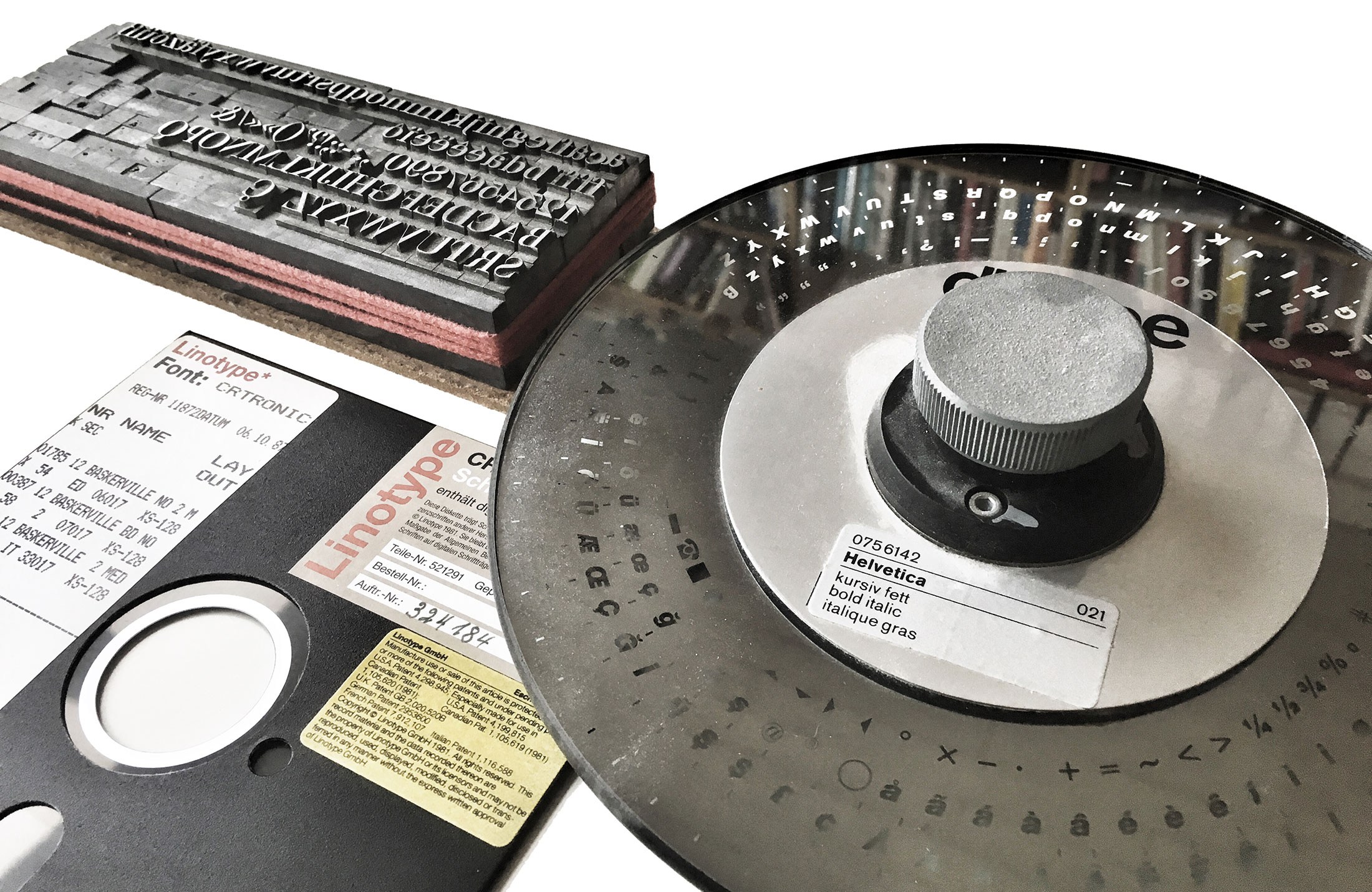
What do these terms mean anyway? The most simple explanation is: a typeface is what you see, a font is what you use. Both refer to a “set of letters (or symbols to put it more broadly) with a specific style”, but the term typeface puts the focus on the artistic work, whereas font points to the actual tool to arrrange and print or display text using a design with a specific style. Considering the most common techniques, this tool can be …
the letters (made from materials such as metal or wood) in a single letterpress type case a phototypesetting disc or strip containing letters as photographic negatives a digital font file containing letters as digital outlines 
Fonts used for different typesetting techniques
In contrast to what one might expect, most dictionaries aren’t of much help either and they demonstrate that the problems around the distinction between the two terms isn’t a new phenomenon caused by computer users with a lack of knowledge about letterpress printing. Most English dictionaries I checked use something like a “set of letters in a particular design” as the key element for the definition—but for both terms! The additional characteristics usually vary. Some limit the terms to printing, others have updated this to include today’s digital use as well. Some mention a specific size for fonts, some make that optional or omit it altogether. 
But most experts in our field probably agree that at its core, it’s about the visual design on the one hand (☞ typeface), and the useable manifestation or instance of this design (☞ font) on the other hand. And this broad definition works for all typesetting techniques. 
The debate
It can’t be denied: The term font is used all the time in our field today. We go to sites like myfonts.com, fonts.com, fontshop.com and download digital font files to put them in a font folder and later use them in our application by opening the font menu. And other designers who see our work might later ask for a “font identification”. 
Still, there are people who reject this use of the word font, because it is not a perfect match with how they might have learned to define it decades ago when they started out with letterpress printing. Yes, fonts for letterpress printing happened to be size-specific. It’s just a physical requirement of this technique. And in a letterpress cabinet, each size of a typeface would be referred to as individual font. But as shown before, this is not necessarily a key element nor a requirement to define the term font for all eternity. Just as with the material by the way. Font (or “fount”) probably comes from the “melting” or “casting” of the metal alloy in order to make the moveable type. Yet, the same term was used when wood type became common, even though nothing is actually melted or casted in this case. Despite the conflict with the “original” meaning of the term font, it made sense to adopt it for wood type as well, because the purpose was the same. And the same thing happened with the shift to scalable fonts with phototypesetting and later digital typesetting. A phototypesetting disc was neither casted from metal nor was it restricted to a specific type size. Yet, just as a letterpress font it was used to typeset a specific type design and that’s why the term font was used as well. Sure, we could also use completely different terms for different typesetting techniques, but using a shared definition for letterpress fonts, phototypesetting fonts and digital fonts is just a normal effective use of language. 
The interchangeable use of font and typeface
Now that we have clarified what the terms mean and why they exist the way they do, let’s move on to the actual question of this article. A typical complaint about today’s use of font and typeface is that the interchangeable use removes the distinction between the terms and so this is something that must be avoided. But in my opinion, that is a flawed logic, which often seems to be based on the assumption that only one term could be correct in any situation. The other extreme—which is also quite common today—is to say we should just give up and accept that these terms are essentially synonyms today. I disagree with both positions. They only propose two possible options: the use of these terms must be exclusive or identical. But that is a false dilemma. There are more options and I want to argue, that the interchangeable use of font and typeface is mostly the result of the fact, that both terms usually apply at the same time and so it just doesn’t matter much which one we pick. 
Let me explain that with an analogy. Take the words “song” and “recording” for example. They aren’t synonyms of course. I can whistle a melody and someone standing next to me might recognize the “song”. The person is standing next to me, listening to me. No recording was involved. But I could also give a talk and someone makes an audio recording of it. There is now a “recording”, but since it was just talking, the word song wouldn’t make sense. Both words have different meanings and in these two examples only one was valid in each case. But if we talk about music albums for example, both terms apply at the same time. There are songs—the musical composition (and optionally lyrics)—and there is a specific recording of that song on a certain album. If we talk about a specific album, it doesn’t matter if we refer to the songs or the recordings on that album. We could mean exactly the same thing. The recordings are the manifestations of the songs and both are bound together. This relationship can be shown in a very simple Venn diagram: 

There can be exclusive and overlapping uses of the terms. It doesn’t have to be “exclusive” or “identical”.  Usually we just refer to a song or a recording by the same name written on the album cover and there are hardly any confusions. The linguistic symbols are pointing to the same thing. But as shown in the diagram, there are exclusive uses as well. A song might appear on different albums of the same artist or even different artists. In this case song and recording clearly point to different things and we need to make sure to use the correct words. 
And I would argue, that typeface and font share the same relationship as song and recording. When a new typeface or family with different styles is released, there will be fonts available to actually use the design or the different designs within the family. It goes without saying. And that’s the overlapping use that explains the interchangeable use. Helvetica Bold Italic is both a typeface and an available font. But that does not mean that typeface and font are synonyms. The exclusive uses remain as well. A type designer sketching letters in a notebook isn’t drawing a font. The designer is working on the visual artwork—the typeface! If the designer ships that typeface in various font formats I might have a folder on my computer with one typeface, but two or more fonts. In such cases an interchangeable use of font and typeface would make little sense and might cause unnecessary confusion. 

Conclusion
Words don’t have intrinsic meanings—words have usages. Therefore it makes little sense to cling to a very narrow metal type definition of the word font, just because that happens to be the first or literal meaning of that word. It’s almost ridiculous to deny the reality of the usage of the word that became common with phototypesetting and digital type. Nothing is lost anyway. It is always possible to apply a broader or more narrow meaning depending on what the specific context requires, as we do it with many other words as well. If necessary, we can use a broader meaning for the word font which covers all typesetting techniques. And at the same time we can create categories and sub-categories to be highly specific about certain types of fonts. The specifics of a letterpress font can still be described by referring to it as “letterpress font” or “wood type font” to be even more specific. 
And in my opinion the interchangeable use of font and typeface is fine, as long as we stay in that overlapping area of the Venn diagram. There can be a fine line between words being used interchangeably in certain contexts and words being synonyms. In this case, it is a difference that matters and one that we should be aware of. 
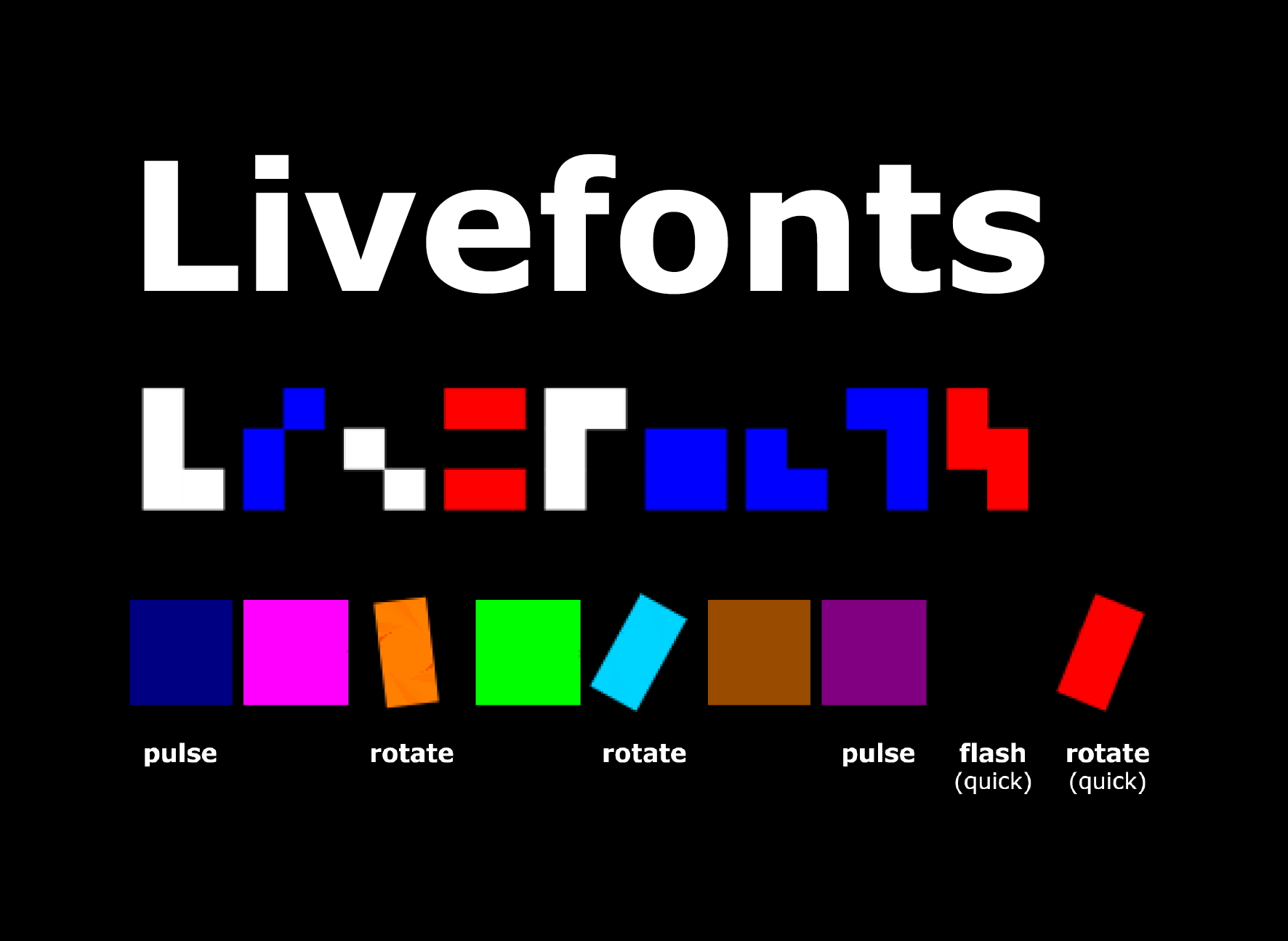
The idea is simple: instead of requiring low vision readers to enlarge the letters until they become legible, a new kind of “script” is being tested, that provides the uniqueness of each character by the means of digital screens: simple block shapes + colors + animations. The combination of these features allows a full character set without requiring the level of detail of traditional typefaces. 

The results look promising. According to the study, the script can be learned with similar effort than existing foreign scripts. And the legibility benefits (which means: being legible with less magnification) could be demonstrated for both readers with low and normal vision. “Increased legibility from livefonts can potentially help reduce or eliminate the magnification needed to identify letters. Sighted users can also benefit, especially people reading small text on small screens, those who wear glasses but do not always have them at hand, and people who need glasses but cannot afford them.”

The study was done by Danielle Bragg (University of Washington, Seattle, WA), Shiri Azenkot (Cornell Tech, New York, NY), Kevin Larson (Microsoft, Redmond, WA), Ann Bessemans (Hasselt University/PXL-MAD School of Arts Hasselt, Belgium), Adam Tauman Kalai (Microsoft Research Cambridge, MA). 
You can read the full paper here:
https://homes.cs.washington.edu/~dkbragg/papers/livefonts.pdf
The following video provides a quick summary. 

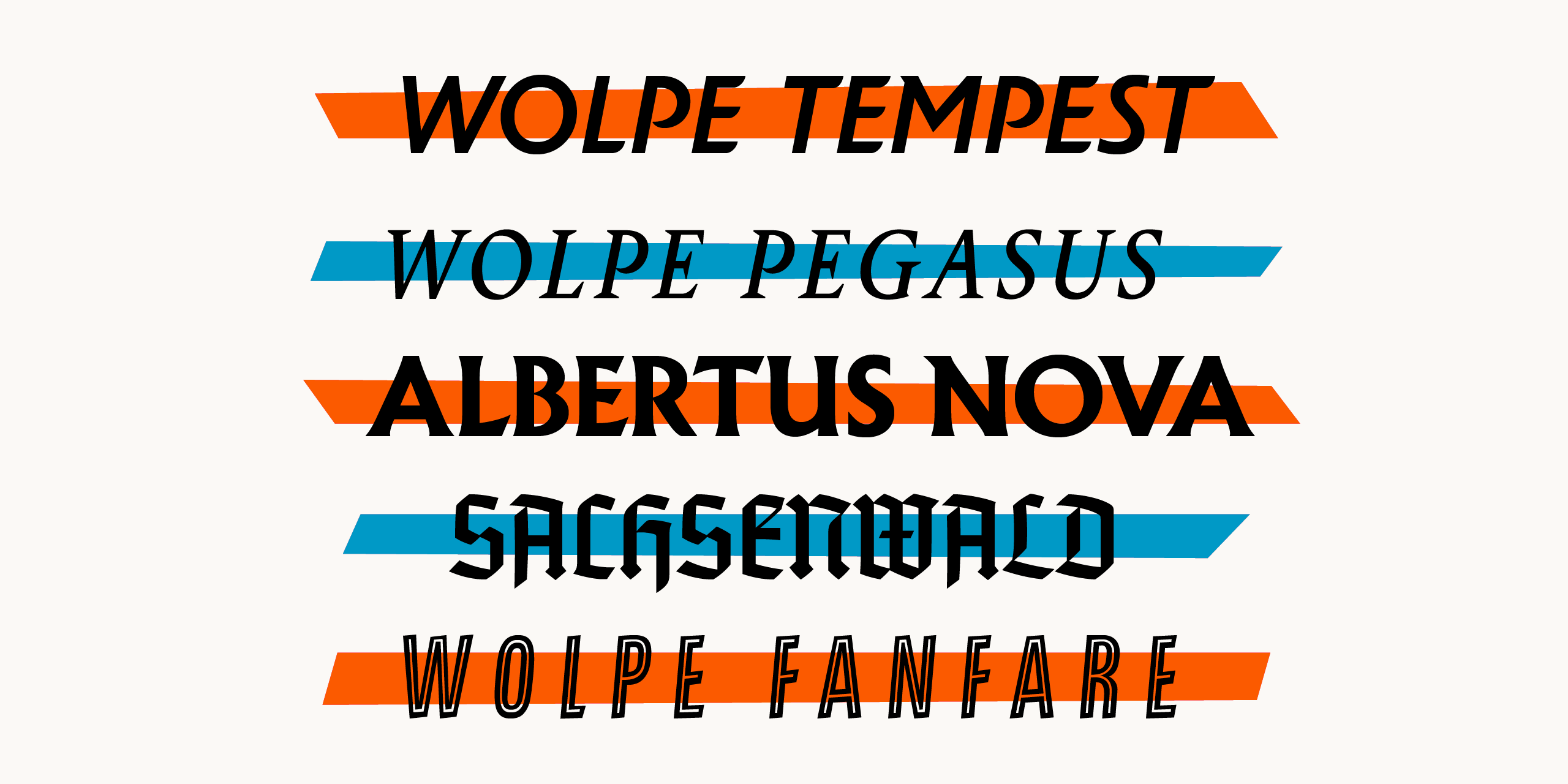
The typefaces were modeled around Wolpe’s original Albertus, Fanfare, Pegasus, Tempest and Sachsenwald designs, embracing their collective quirks and deliberate inconsistencies. “The inconsistencies in Wolpe’s designs were freeing in the sense that it taught me to challenge conventional design and rethink how typefaces should be constructed,” said Toshi Omagari, Type Designer at Monotype. “Wolpe made compromises in his designs due to the limitations of typesetting in his time. However, the modern digital environment means that typefaces can be revised to capture his original design vision and applied across a wide range of offline and online media.”
Wolpe’s designs achieved varying levels of popularity when they were first created, but weren’t meant to be used exclusively in their era. And while the Albertus typeface has been used in some modern applications, the others were never digitized, and as a result, faded from view. Monotype saw the opportunity to revive these designs with contemporary appeal and flair.


Albertus Nova has been expanded to include a set of small capitals and five weights. The fonts incorporate original designs including a new capital J and Q and fixing different proportions and lost details of characters. The Albertus Nova typeface also reintroduces a number of alternate capital letters originally created by Wolpe, including an unusual M with a lower apex and a slanted left stroke, a W with crossing center strokes, a 2 with a closed loop, and an open ampersand. Monotype has also added new designs including an A with a top bar, a lunar-shaped lower and upper E and a long-tailed Q and R.


The Fanfare typeface was built for Fanfare Press in 1935 and has graced hundreds of book covers. The sharp resolution of digital media makes the Wolpe Fanfare typeface great for display use. It is available now in six weights. 

Building off the original Pegasus typeface commissioned by Monotype in 1937 as the text companion to the Albertus design, the Wolpe Pegasus design takes advantage of its predecessors’ inconsistencies. For example, characters that would conventionally share details, such as b, d, p and q, don’t share them in this set. Additionally, some serifs in the uppercase alphabet of the Pegasus typeface are different. This was a conscious effort by Wolpe to create individual letterforms. Wolpe Pegasus keeps every convention-defying detail of the original character set and adds Regular and Bold weights (with italics) as well as small caps and various sets of numerals.


The Tempest typeface was originally created exclusively for use on book jackets by Fanfare Press and, despite being designed in the mid-1930s. The revived Wolpe Tempest design continues on its original path to set itself apart from the formal and static sans serif italic typefaces of that era and offers three weights, including Regular, Bold and Black, preserving Tempest’s unmistakable profile and skeleton. It also offers alternates for the A, B, D, E, L, M, N, P, R, X, Y and Z characters which sport flourishes on entry and exit strokes, and are great for adding extra embellishments to book titles, logotypes and headlines.


Monotype has digitized the original Sachsenwald typeface for the first time, adding an alternate X character to the original set to make it more legible. Wolpe first created the Sachsenwald design for a German publisher, who abandoned the order just before World War II. Wolpe then tried to make the Sachsenwald typeface suitable for use in the general public, with the hope that it would ignite the interest of “horizon-scanning advertisers” and create a “passing vogue” for blackletter type. The letterforms are softer and less decorative than traditional blackletter script. However, the use of blackletter type declined in favor of more legible Roman type within Germany and was not popular in other regions of the world – keeping the Sachsenwald typeface from achieving wider adoption at that time. Monotype saw the opportunity to revive and preserve a beautiful design and bring it into the modern era – as blackletter usage becomes more commonplace in areas such as publishing, fashion and album covers.
The Wolpe Collection is available now. The Albertus Nova, Wolpe Fanfare and Wolpe Tempest designs are available in Latin, Greek and Cyrillic. The Wolpe Pegasus and Sachsenwald designs are available in Latin, only.
When the German lowercase letter ß (“sharp s”) was standardized and added to all German typefaces around 1900, the addition of a capital version was planned as well. But the introduction was postponed, because the committee couldn’t agree on a design in time. In the end it took over 100 years to get the ball rolling again. 


Fonts with a Capital Sharp S made in the early 20th century. Their use didn’t catch on and it wasn’t part of the German orthography. 
The discussion around the missing uppercase letter started again in the 21st century after changes to the German orthography, which reduced the occurrences  of the letter ß, but gave it a more distinct phonetic function. But this function was lost when texts were set in uppercase only and German names became ambiguous as well. So once again, the introduction of a Capital Sharp S was proposed. In 2008 it was added to the Unicode standard and after that type designers could start to add it to their typefaces. More than a thousand new type families containing a Capital Sharp S have been released since then—and a keyboard layout with support for the Capital Sharp S was standardized as well. 

A children’s book from 2014 using a Capital Sharp S
And even though the letter wasn’t yet part of the official German orthography, more and more people started to use it. The Council for German Orthography as well as the publishers of German dictionaries like Duden had acknowledged the usefulness of a Capital Sharp S years ago, but they couldn’t prescribe the use of a letter that wasn’t available on keyboards and in fonts. 
Eight years after the addition to the Unicode, the Council for German Orthography decided that the time was now right for an uppercase ß. They proposed a change to the orthography in 2016 and after the approval process in all the countries using the German language the change became official in June of 2017. 

The change doesn’t mean that everyone now has to use a Capital Sharp S. The previous spelling of replacing ß with SS in uppercase texts remains the default for the time being. But using the Capital Sharp S is now officially allowed as well and wouldn’t count as spelling mistake anymore. 
Addition Information:
Press Release of the Counsil for German Orthography (in German) The Multifaceted Design of the Lowercase Sharp S (ß) Capital Sharp S – Germany’s new character How to draw a Capital Sharp S Capital Sharp S designs. The good, the bad and the ugly. The Capital Sharp S in Use
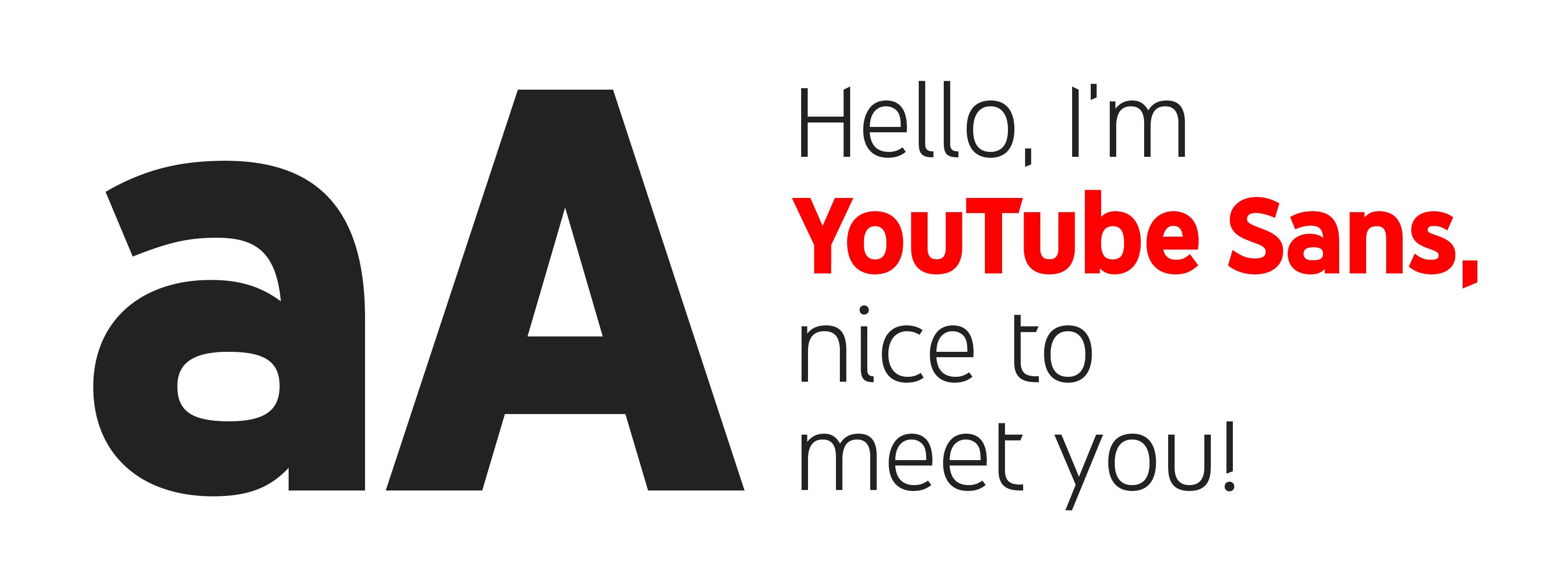
YouTube Sans was created by Saffron in partnership with Letterjuice in Barcelona and URW++ in Hamburg. Unfortunately, Saffron’s presentation page for the project rather feels like a sales pitch—or a parody of such presentations. We see typical clichés like adding construction circles to the finished artwork. Almost funny are the following images, that honestly want to draw a connection between the rounded YouTube play button and the execution of the YouTube Sans letters, such as the G. You know that this would be true for the vast majority of typefaces, right? And the tension of the specific arcs isn’t even similar. 


But all this marketing talk aside, what about the type design itself? Currently YouTube Sans comes in several upright weights. The overall look of the design isn’t anything spectacular. A modern sans-serif design leaning towards geometric designs, which are very popular currently. So its not really a bold choice, but the execution does have a subtle uniqueness, which could certainly be sufficient to serve the branding requirements of a custom font.  
 

But type designers have critizized the execution of the design. 
Both looking at the details, like how arcs and stems meet, as well as how letters work together, the design doesn’t feel as consistent and professional as it could be. Its easy to point to successful retail typefaces in the same general sans-serif category with much better execution and visual consistency.
But the biggest flaw of the design is certainly the use of another branding cliché: randomly cutting off corners of letters. A trend so big, that has its own Tumblr feed as a “hall of shame”. 
Yes, its lazy and there is never an acceptable justification for it. Just because its so easy to do in your vector design app, doesn’t make it desirable. Stroke endings can take on many different shapes, but in the end (or on the end in this case), consistency is key. It goes back to the roots of typefaces in writing, where the stroke endings were a result of the writing tool and the angle one would hold this tool. Rounding or cutting off corners arbitrarily can only lead to an inconsistent and distracting appearance. Explaining it through the angles of the YouTube play button triangle might be a nice gimmick in a pitch, but it doesn’t do anything useful in the real-world use of the type family. 

YouTube Sans on the YouTube TV welcome page
You can see YouTube Sans in use here. The bold headlines do their job quite nicely. This is where your custom (display) font can shine. The legibility of the smaller text isn’t as good though. Google’s Roboto, recently rolled out on youtube.com works much better in such cases. It will be interesting to see how these different typefaces will be used and possibly combined in the future. 
What’s your opinion on YouTube Sans? Feel free to share your thoughts in the comment section below. 
Links:
analysis by Nina Stössinger on Typographica
I began reading books about Renner and Kramer to straighten my mind about who really made the first design of Futura. At the end Futura is even today one of the most popular typefaces.
Right or wrong?
The book by Christopher Burke about Paul Renner (Hyphen Press, 1998) was a good start to read. The second was an article by Burke about ‘The Authorship of Futura’ in Baseline 23 (1997) that should bring me on the right track. In this article Burke widens this authorship to the design staff of Bauer Type Foundry. Not strange when you look at the complex production of a typeface in that period of time, but sadly it makes my research not easier. Technical support by foundries played a big role in almost every type design in the lead era. Often the typedesigners where artists or architects by profession and could not oversee all the aspects of the production process. Luckily Burke also gave some publications to read further. One is an article from the author Hans Peter Willberg (Tiessen, 1969). Willberg writes that Kramer was a student at the Städel-Schule in Frankfurt in 1925 and that he made there the first drawings on which Renner based his design on Futura. But Kramer was in 1925 already a well-known architect and product designer and was working at the building department of the city of Frankfurt. He never attended the Städel-Schule as far as I know. Renner began with his first drawings for Futura in 1924 and winter 1924/25 first cuts of Futura were already done by Bauer Type Foundry. So both assertions of Willberg where wrong.
Setting the dates
The most used piece of evidence about Kramer-Grotesk is a sheet of paper that shows capitals of Futura with some of them in outline that are crossed out. Elsewhere on the sheet alternative characters for the crossed out capitals are enclosed [picture 1]. In a lot of publications this sheet is dedicated to Kramer.

Picture 1: Bauer, Konrad F., Wie eine Buchdruckschrift entsteht, 1958
So I had to figure out when this designsheet was first published and why it was attributed to Kramer. Since most of the material of Bauer Type Foundry is supposed to be destroyed during World War II I first looked at publications from before this war. One important publication is an article by Denis Megaw in ‘Typography 7’, published in 1938. On page 34 drawings are shown that are presented as the first designs of Futura by Renner. These are the lower case characters and capitals that are placed on top of the page in picture 2.Below this a complete set is shown from Futura as published by Bauer in 1927 in its final form (without the extra alternative characters).

Picture 2: Megaw, Denis, Typography 7, 1938
The sheet of paper with sketches [picture 1] show in black more or less the definitive forms of the capitals of Futura while the outline forms are showing his first designs from 1924 for the A and K as in Megaw’s article. An invitation card for a lecture dated 3. July (1925) [picture 3] made with trial cuts of Futura by Bauer show also these capitals that are in a state between the first designs in the article from Megaw and the final ones on the same sheet. 

Picture 3: Luidl, Philipp and Lange, Günter Gerhard, Paul Renner (Eine Jahresgabe der Typographischen Gesellschaft), 1978
Look for example at the M, N and R. The same story is told by a trial setting that was made for the publication ‘Schrift’ by F.H. Ehmke that was published on July 9th 1925 [picture 4]. 

Picture 4: Ehmcke, F.H., Schrift, ihre Gestaltung & Entwicklung in neuerer Zeit, 1925
You have to keep in mind that at that time making a book would have taken several months from concept to printed matter. As described by Paul Renner in ‘From Georg-Müller book to Futura and Meisterschule; recollections by Paul Renner’ (translated), published in 1940 and 1943, he reports that he showed slides (Lichtbilder) of Futura by Bauer Type Foundry already in February 1925 during lectures at large printing firms in Cologne and Mönchengladbach.
Renner meets Kramer
In May 1925 Renner moves from Munich to Frankfurt to teach at Fritz Wicherts Frankfurt Art School (the former Städel-Schule). He also meets Wicherts friend Ernst May who is head of the building department of the city of Frankfurt. Another person he met was the architect Ferdinand Kramer who was also working at this department. Ernst May had ambitious plans for rebuilding parts of the city of Frankfurt. A lot of inspiration for the plans came from the Bauhaus and buildings of the Stijl in The Netherlands. One of the examples also published in the magazine ‘Das Neue Frankfurt’ was De Unie in Rotterdam by Architect Oud. On that building geometrical sans serif typography is clearly an essential part of the architecture. May asked Renner to deliver a typeface that could be used in architecture as well as on shops, advertising and small structures like bus stops. I think that the sheet that was delivered by Renner to the building department is the sheet that also can be found in the ‘Werkkatalog Ferdinand Kramer 1923-1974’ by Jochem Jourdan.
In this ‘Werkkatalog’ the designsheet of letterforms is dated 1925 on the back (according to Jourdan). The stencil typeface on the left of picture 5 is not discussed in origin, dated 1952, and made by Kramer. With the sheet to the right the discussion of the Kramer-Grotesk started but it is a different sheet than the one most publications about Kramer-Grotesk use to discuss this issue. For example in ‘Baseline’ (‘The authorship of Futura’ by Chistopher Burke) and several other publications the sheet in picture 1 is presented as the Kramer-Grotesk sheet. I think the sheet from the ‘Werkkatalog’ was credited to Kramer simply because it was found in his archive. I personally think that this is a copy or the original that Renner delivered at the building department for copying and distributing to letter sign firms and architects that worked in Frankfurt. There are some slight differences between the characters (for example the J and S) between the trial settings from 1925 of Bauer Type Foundry and the capitals on this sheet but that could be a design decision by Renner for the architectural purpose of this set. ‘Das Neue Frankfurt’ [picture 6] in january 1927 shows the typography of the fassade of the hat shop of Ferdinand Kramers parents in Frankfurt using the capitals of Futura. This design and the design of a second shop fassade on that page is credited to Renner. Also the name of the typeface (Futura-Groteske) is mentioned in the caption of the second picture. Some slight alternations to the characters can also be caused by sign makers who had to take over the letterforms from the drawings of Renner. At that time no computers, scanners or laser equipment where available to do that. 

Picture 6: Behne, Adolf, ‘Kultur, Kunst und Reklame’ in: Das Neue Frankfurt 3, 1927 (digital file uni-heidelberg)
Renners design process
I think that looking at the consistence of the design process of Futura by Renner there can be no doubt that Kramer-Grotesk is a myth. The drawings on picture 1 can clearly be seen as stage three in the design process. The first step was the line ‘Die Schrift unserer Zeit’ from 1924 from which all started (not available but mentioned in Renners writings), second where the drawings in ‘Typography 7’ (picture 2) and third was to my opinion the much discussed sheet from picture 1. The crossed-out capitals on that sheet match with the earlier design of the capitals of the top drawings in picture 2. It can be seen as a logical step to the trial settings of picture 3 and 4 in 1925. The sheet found in the Kramer Archive has to be looked at as a separate design of Renner but fits in the stage of the design of Futura at that moment. For me and for most typedesigners it is also quite clear that it would almost impossible to draw ‘out of the blue’ an alphabet with such a quality and consistance between the characters, especially when you hardly have any experience in graphic design like Ferdinand Kramer had. Although Renner was also not a typedesigner by profession he was 23 years older than Kramer and had loads of experience in graphic design, had been teacher in graphic design at his own school and had already written a well-received book about typography. There is a sheet with a stencil typeface [picture 5 on the left] in the Kramer Archive that is to me clearly a typeface design of an architect. Drawn on the drawing table with rule and compass. The ‘B’ with the same top and bottom curve, the ‘S’ with a top that is too large and an ‘O’, ‘Q’ and ‘G’ that has the same vertical and horizontal line thickness. And that typeface is dated 1952, a quarter of a century later. See also picture 11 with the timeline of the alledged Kramer-Grotesk designsheet. Of course there where architects like Peter Behrens who created typefaces but mostly architects who did where more active in graphic design and typedesign than Kramer and did this with support of a very experienced design staff of a foundry. Kramer-Grotesk on the contrary is supposed to be created without that help. 

Picture 7: Hahn, Peter, Ferdinand Kramer Architektur & Design, 1982
One of the publications that helped me a lot in this research was the thesis of Charles C. Leonard ‘Paul Renner and Futura: The Effects of Culture, and Social Continuity on the Design of Type for Printing’ that he published in 2005/2006. Leonard thoroughly researched the drawings shown in ‘Typography 7’ as well as the disputed design sheet from ‘Wie eine Buchdruckschrift entsteht’ (How a new printing type is made) of Bauer Type Foundry in 1958 [picture 8].

Picture 8: Bauer, Konrad F., Wie eine Buchdruckschrift entsteht, 1958
It is very interesting to see how he did a lot of work comparing designsheets of Renner (see picture 12). The ‘Kramer-Grotesk’ sheet shown in picture 5 on the right has the same cap-height and could easily be put in the comparison and would match the other two. One thing that Leonard presumes falsely is that the designsheet (picture 1) from 1958 was a reprint of the publication of Bauer from 1931 [picture 9].

Picture 9: Bauer, Konrad F., Wie eine Buchdruckschrift entsteht, 1931
This publication was completely different. Bauer Type Foundry used this first publication to promote the typeface Beton from Heinrich Jost that was new in 1931. All the illustrations and text went about that typeface. In 1958 the publication had as subject Futura that was a longrunner in sales at Bauer. So the designsheet of Futura that was published in the 1958 publication was first published in that year and never before as far as I know. So I think that this sheet was never even near Kramer as presumed by Christopher Burke in the caption of Baseline and has always been in the archive of Bauer Type Foundry (untill WW-II) being one of the designs of Renner. In the caption of the 1958 publication of Bauer the design is dated 1925 but because Renner showed first cuttings during lectures in february 1925 (see above) and Burke also writes that first trial cuts by Bauer were done in the winter of 1924/25 I think that this could also be an earlier design and maybe has to be dated before the trial cuts were made.
Recent publications
Recent publications from 2016 that publish the discussed design sheet from picture 1 are ‘Futura. Die Schrift.’ and ‘AllesNeu!’. They are a feast for the eye showing a lot of type specimen and printed matter with Futura. In ‘Alles Neu!’ some strange things are happening. The publication ‘Schrift’ by Emcke with a preliminary test (Vorprobe) of Futura is dated at 1926/27 while above in the picture the date of July 9. 1925 is even quite visible. On the same page the designsheet [picture 1] that was dedicated to Renner at first publication in 1958 is suddenly subscribed to Ferdinand Kramer. The source of the picture is not given. The article of Katherina Pennoyer with the subtitle ‘So far unknown facts and details’ (bisher unbeachtete Fakten und Details) indeed gives some more details that according to her gives Kramer a bigger role in the creation of Futura. She writes again that Kramer studied at the Städel-Schule in Frankfurt (p. 99). As written before Willberg introduced this false story in 1969 (see above). I cannot find any proof of that (see picture 8: Timeline Renner and Kramer). About the text of Paul Renner on his recollections of the design of Futura, published in 1940 and 1943, Pennoyer writes: ‘It seems that the story was written by those who earned money of it’ (Es hat den Anschein, dass die Geschichte von denen geschrieben wurde, die daran verdienten). So according to her Renner did not write the article about that important part of his life himself. But Renner never rejected the article and accusing him and Bauer Type Foundry of a story that is false is far beyond the reputation of Paul Renner and Georg Hartmann, who was beside being owner of Bauer Type Foundry also a bibliophile and patron of the arts in many ways. I think we should leave that remarkeble text to the responsibility of Pennoyer and the publishers of ‘Alles Neu!’. Her mentioning that Renner and Kramer could have met in 1919 when they both where living in Munich can nowhere be verified. Renner left Munich in 1919 and Kramer came to live there in 1919 (see timeline picture 10). Renner was also 23 years older than Kramer and could have had a totally different circle of friends. But ‘never say never’, Renner had to be sometimes in Munich for his work for the publisher Georg Müller and I would gladly like to get information about them meeting at that time and place.

Picture 10: Pohlen, Joep, ‘Timeline Renner-Kramer’, Roermond, 2017
The book ‘Futura. Die Schrift’ is thoroughly written and researched. Of course the famous sketches page [picture 1] is also present in this publication but it is left in the middle who made it actually. Interesting is however that this picture is taken from a whiteprint (Lichtpause) from the Klingspor Museum. So another source than the earlier publications (picture 11).

Picture 11: Pohlen, Joep, ‘Designsheet Paul Renner (also known as Kramer-Grotesk)’, Roermond, 2017
According to the author Petra Eisele the whiteprint is 98% of the original. And that is peculiar because whiteprints where copied in contact with the original using the diazolid (or Ozalid) process. So it should be 100% or close to it. I asked specialist Ed Kemmerling who worked for 28 years in the business of copying architectural drawings. He also thought that 98% is quite a difference. The aim is 100% because builders often use it to measure. But a difference is not impossible according to the process and machines used. I mailed with Klingspor Museum to learn how this whiteprint got in their collection but the answer is that they don’t know because they have it for a long time. But Klingspor has also proofsheets showing trials of letters with some characters glued over earlier letters. And on some sheets all the letters are glued on separately. These sheets are shown for example on page 38-41 in ‘Futura. Die Schrift.’. These must to my opinion descend from the studio of Bauer Type Foundry because there is a typical way of working to reach the final design. They are dated in the book from 1926 to 1928. The source that delivered them to Klingspor could also have delivered the sheet from picture 1 that is in their archive. But that’s speculation …
Conclusion
The thing that remains and is hard to understand is why Ferdinand Kramer did not protest against this so-called Kramer-Grotesk that was published in several important publications like the Bauhaus-Archiv publication ‘Ferdinand Kramer Architektur & Design’ in 1982 when he was alive and kicking (although he was at that time 84 years old). Kramer was an architect who had a very good reputation as product designer and architect and one could say that he did not need this credit for Kramer-Grotesk. The capitals of Futura were already developed in the definitive form in the beginning of 1925 but the lower case characters still had to go a long way to meet the final design. Maybe the development of this lower case letters were part of the discussions Renner had with Kramer and it could be that the huge transformations of these designs strengthened Kramers idea that he participated in the design of Futura. But Renner discussed it with more people. I also read somewhere that according to the wife of Jan Tschichold he also thought that he had contributed because he discussed the design with Renner. Neumann mentioned in his article in ‘Ferdinand Kramer’ from 1991 that Kramer did say (gesprächsweise) that he considered himself as one of the ‘fathers’ of Futura. This is all speculation but I can find no other reason why Kramer did not reject the publication of Kramer-Grotesk and his role in the design of Futura like stated in the caption on page 33 in the Bauhaus-Archiv publication [picture 7].
Despite the findings this story leaves an odd taste in my mouth about the role of Ferdinand Kramer. Or maybe the ones that believe they serve his legacy. With my limited knowledge I think that Kramer himself never wrote about designing Kramer-Grotesk. But maybe others can look into that and could find more about Kramers personal view about this. 
Joep Pohlen, May 2017
 
Literature:
Bauer, Konrad F., ‘Wie eine Buchdruckschrift entsteht’, 1931, Frankfurt (DE) Bauer, Konrad F., ‘Wie eine Buchdruckschrift entsteht’, 1958, Frankfurt (DE) Behne, Adolf, ‘Kultur, Kunst und Reklame’ in: ‘Das Neue Frankfurt’ 3, 1927, Frankfurt (DE) Burke, Christopher, ‘The authorship of Futura’ in: Baseline 23, 1997, East Malling (UK) Burke, Christopher, Paul Renner, the Art of Typography, 1998, London (UK) Ehmcke, F.H., ‘Schrift, ihre Gestaltung & Entwicklung in neuerer Zeit’, 1925, Hannover (DE) Eisele, Petra, Ludwig, Annette and Naegele, Isabel, ‘Futura. Die Schrift.’, 2016, Mainz (DE)  Hahn, Peter, ‘Ferdinand Kramer Architektur & Design’, 1982, Berlin (DE) Hansert, Andreas, ‘Georg Hartmann (1870-1954), Biografie eines Frankfurter Schriftgießers, Bibliophilen und Kunstmäzens’, 2009, Vienna (AT)  Kemp, Klaus and Wagner, Matthias K., ‘Alles Neu!, 100 Jahre Neue Typografie und Neue Grafik in Frankfurt am Main’, Stuttgart, 2016 (DE) Leonard, Charles C., ‘Paul Renner and Futura: The Effects of Culture, and Social Continuity on the Design of Type for Printing’, 2006, Georgia State University (USA)  Lichtenstein, Claude, ‘Ferdinand Kramer, der Charme des Systematischen’, 1991, Gießen (DE): the article ‘Frankfurter Typografie’ from Neumann, Eckhard, pp 32-34 Luidl, Philipp and Lange, Günter Gerhard, ‘Paul Renner (Eine Jahresgabe der Typographischen Gesellschaft)’, 1978, München (DE) Megaw, Denis, ‘20th Century Sans Serif Types’ in: ‘Typography 7’, 1938, London (UK) Renner, Paul, ‘Vom Georg-Müller-Buch bis zur Futura und Meisterschule; Erinnerungen von Paul Renner’ in: ‘Imprimatur’ 9, Ein Jahrbuch für Bücherfreunde, 1940 Renner, Paul, ‘Vom Georg-Müller-Buch bis zur Futura und Meisterschule; Erinnerungen von Paul Renner’ in: ‘Gebrauchsgraphik’, Heft 5, 1943, Berlin (DE) Stresow, Gustav, ‘Paul Renner und die Konzeption der Futura’ in: ‘Buchhandelsgeschichte’ Nr. 51, 1995, Frankfurt (DE) Willberg, Hans Peter, ‘Schrift im Bauhaus/Die Futura von Paul Renner’ in: ‘Monographien und Materialien zur Buchkunst’, Band 2, 1969, Neu-Isenburg (DE) 

Important Information

We are placing functional cookies on your device to help make this website better.

Account

Navigation

Search

Search

Configure browser push notifications

Chrome (Android)
  1. Tap the lock icon next to the address bar.
  2. Tap Permissions → Notifications.
  3. Adjust your preference.
Chrome (Desktop)
  1. Click the padlock icon in the address bar.
  2. Select Site settings.
  3. Find Notifications and adjust your preference.